Linking verbs link the subject of the sentence with the rest of the sentence by renaming and describing the subject of the sentence with a noun, pronoun or adjective. Linking verbs do not express action and they do not help the main verb.
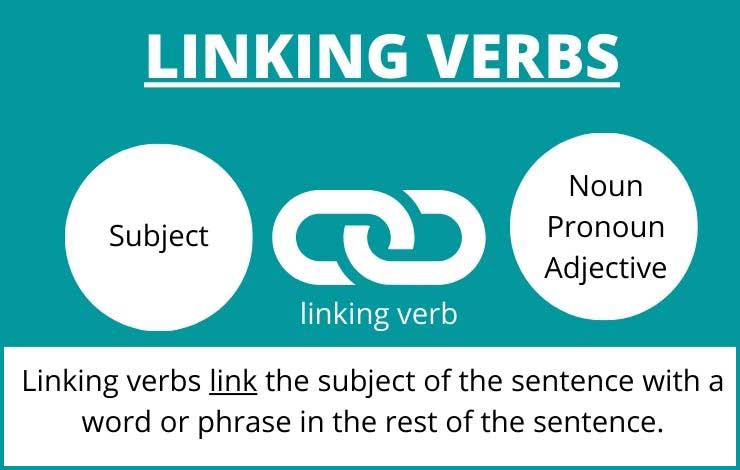
What are Linking Verbs in simple terms?
- Linking verbs do not express action. They are not action words.
- Linking verbs do not help the main verb. They are not helping verbs.
- Linking verbs are verbs that link the subject of the sentence with a word or phrase in the rest of the sentence.
Some Examples of Linking Verbs in Sentences
- Peter is smart. (linking verb is)
- Mark was the teacher at the local college. (linking verb was)
- They were thirsty during the marathon. (linking verb was)
- Candice has been sick during the holidays. (linking verb phrase has been)
- Robert seems agitated by the barking dog. (linking verb seems)
- Steven might have been overwhelmed by the heat. (linking verb phrase might have been)
- The lollies tasted terrible. (linking verb tasted)
- He turned violent during the discussion. (linking verb turned)
- They are jealous of his situation. (linking verb are)
- He appeared calm during the debate. (linking verb appeared)
A List of Some Linking Verbs
In the list of linking verbs below, there are three categories of linking verbs. There are state-of-being verbs, verb phrases and verbs that function as linking verbs.
| State-of-Being Verbs | Verb Phrases | Verbs Used As Linking Verbs |
|---|---|---|
| is | can be | appear |
| am | could be | become |
| are | has been | feel |
| was | had been | look |
| were | have been | seem |
| be | may be | sound |
| might be | taste | |
| might have been | grow | |
| remain | ||
| smell | ||
| stay | ||
| prove |
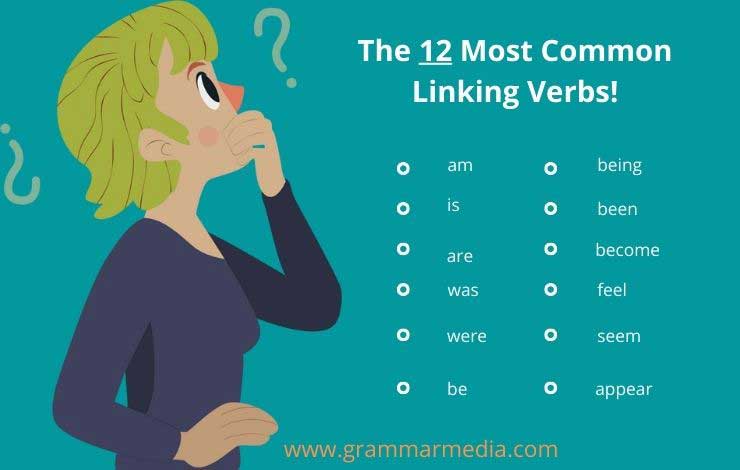
What are the 12 most common linking verbs with examples?
The 12 most common linking verbs are: am, is, are, was, were, be, being, been, become, feel, seem and appear.
Let’s look at some examples of the 12 most common linking verbs!
- I am poor.
- He is rich.
- They are the people fleeing the devastation of the flood.
- Jennifer was the teacher at the college.
- Jimmy and John were hungry after a weekend without food.
- This might be the decision she has been waiting for.
- Jonathan was being silly.
- He has been a policeman for many years.
- They became sick after traveling overseas.
- Linda feels disappointed by the bad news.
- They seem agitated by the loud noise.
- It appeared new when we bought it.
What are true linking verbs?
Here are some features of true linking verbs!
- True linking verbs are always linking verbs.
- True linking verbs always connect the subject to additional information in the sentence.
- True linking verbs are forms of “to be,” “to become” and “to seem.”
Here are some true linking verbs: am, is, are, was, were, become, became, seem, seemed, etc.
True linking verbs always perform a connective function between the subject of the sentence and the rest of the sentence by showing a relationship or describing a state.
Here are some examples of true linking verbs in sentences!
- Jennifer is sick with the flu! (“is” connects Jennifer to her state of being “sick”)
- My students are busy with their assignments.(“are” connects students to the state of being “busy”)
- They were excited with the outcome of the test. (“were” connects they to the emotional state of “excitement”)
- She became a teacher after many years of study. (“became” connects she by showing a relationship with “teacher”)
- It seemed impossible at first. (“seemed” connects it to the state of being “impossible”)
Some linking verbs can be action verbs!
English grammar can be a little bit tricky at times and linking verbs fall into that category.
What are some linking verbs that can be action verbs also? These verbs are: look, touch, smell, appear, feel, sound and taste. (see table above)
Here are some examples of linking verbs that can be action verbs also!
- The student looked excited by his test results. (linking verb)
- The student looked for the test results before class. (action verb)
- The dog smelled bad. (linking verb)
- The dog smelled the boy’s lunchbox. (action verb)
- The apple tasted good. (linking verb)
- Candice tasted the apple. (action verb)
How to test for linking verbs?
Remember linking verbs tell us what the subject is, not what the subject is doing.
There are a couple of ways to test if a verb is linking or action. Here are two common ways of testing for linking verbs:
- Replace the singular verb in the sentence with “is” or “was” or plural verb with “are” or “were.” If it makes sense, it is a linking verb.
- Replace the verb with an equal sign (=) and if it make sense, it is a linking verb.
Let’s test the examples above!
- The student looked excited by his test results.
- The student is excited by his test results. (it makes sense – linking verb)
- The student looked for the test results before class.
- The student is for the test results before class. (doesn’t make sense – not a linking verb)
- The dog smelled bad.
- The dog is bad. (makes sense – linking verb)
- The dog smelled the boy’s lunchbox.
- the dog is the boy’s lunchbox. (doesn’t make sense – not a linking verb)
- The apple tasted good.
- The apple = good. (makes sense – linking verb)
- Candice tasted the apple.
- Candice = the apple. (doesn’t make sense – not a linking verb)
Let’s test your skill for identifying linking verbs!
To find the correct answers to these examples, check below the video!
- David felt tired after the long walk.
- David felt the warm sunshine during the day.
- Jenny smells the perfume.
- Jenny smells nice with that new perfume.
- I looked awesome in the new outfit.
- I looked at the new outfit at the store.
Correct Answers To Test Above!
1. Linking Verb
2. Action Verb
3. Action Verb
4. Linking Verb
5. Linking Verb
6. Action Verb