Conjunctions are easy enough to understand for most people. However, this post will look specifically at subordinating conjunctions. Subordinating conjunctions are words that connect two clauses of unequal importance.
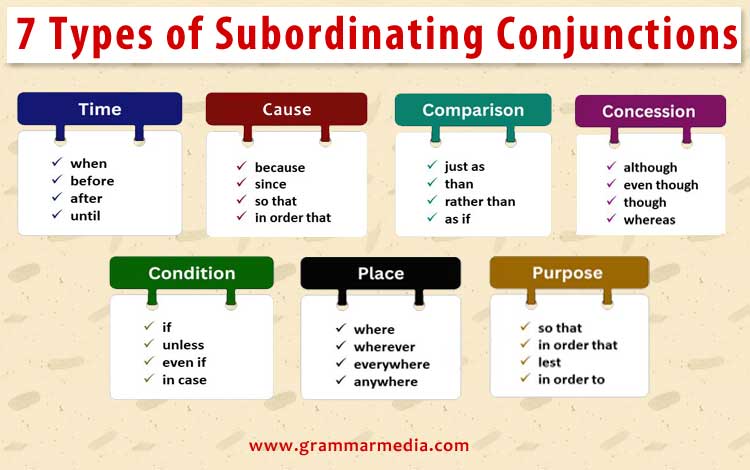
Subordinating conjunctions connect dependent and independent clauses to show the relationship between them. These 7 types of subordinating conjunctions are time, cause, comparison, concession, condition, place, and purpose.
7 Types of Subordinating Conjunctions
What are Subordinating Conjunctions?
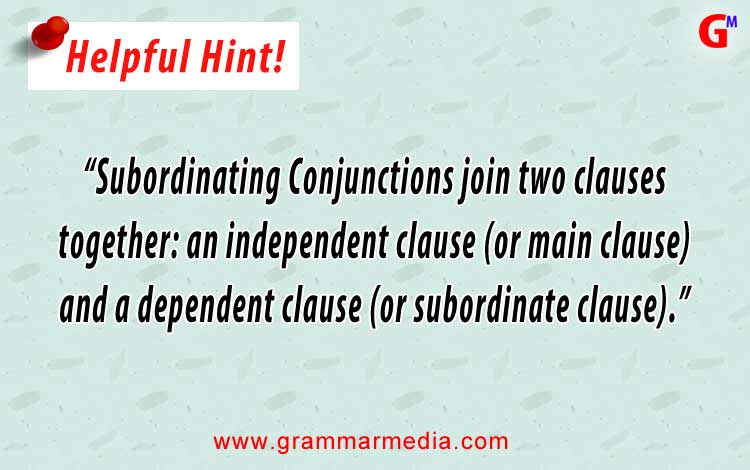
Subordinating conjunctions are words that connect two clauses of unequal value; namely, dependent clauses to independent clauses. These conjunctions introduce the dependent clause and show how it relates to the independent clause.
For example, in the sentence “I will go to the park if it stops raining,” the subordinating conjunction “if” introduces the condition (it stops raining) that must be met for the main action (I will go to the park) to happen.
Even though a subordinating conjunction connects clauses, it still acts as a conjunction by linking the main or independent clause (the sentence’s main idea) to the subordinating or dependent clause. The dependent clause cannot stand alone as a complete sentence and relies on the independent clause for context. This kind of clause adds extra information or details to the main idea.
Understanding subordinating conjunctions helps in constructing sentences with complex structures and relationships between different parts of the sentence.
What are the 7 Types of Subordinating Conjunctions?
There are 7 main types of subordinating conjunctions, each type distinctly connecting independent and dependent clauses, showcasing various relationships between them.
Understanding these 7 types is crucial as they provide a framework for organizing ideas and information in complex sentences, enhancing the clarity and coherence of writing.
Mastering the use of subordinating conjunctions allows you to create more sophisticated and structured compositions, improving overall writing skills.
7 Types of Subordinating Conjunctions
Let’s look at each type of subordinating conjunction and how they show a relationship between independent and dependent clauses. We will look at several examples for simplicity and clarity.
1. Subordinating Conjunctions Showing TIME
Some TIME Subordinating Conjunctions: once, as soon as, after, when, before, until, while, and whenever
Definition: These subordinating conjunctions link two clauses together by showing a time relationship between them.
For Example:
- Once we shift all the rubbish, we will be able to mow the lawn.
- The lecture will begin as soon as the professor returns.
- Before the invention of smartphones, people used to communicate differently.
- Jenny freaks out whenever she sees a cockroach.
- After the party finished, we cleaned up the mess.
- The property owners checked the damage after the storm had passed.
- Whenever I hear that music, it reminds me of the good old days.
- I finished mowing the lawn while you were cleaning out the shed.
- While I waited for the parcel, I finished my work.
- My mother always made us brush our teeth before we went to bed.
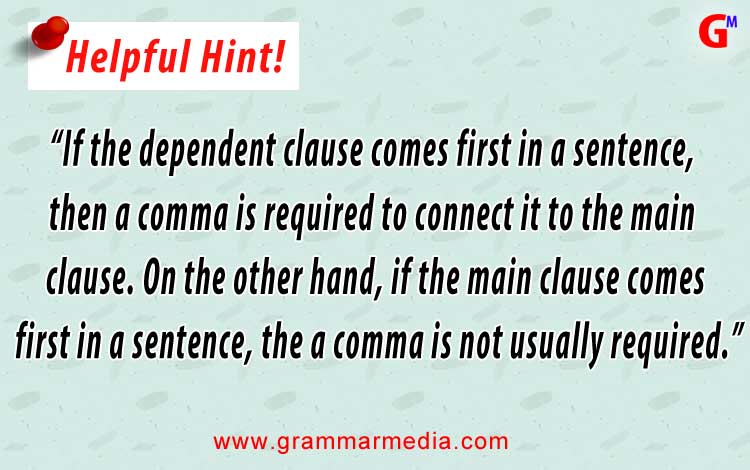
Helpful Hint: If the dependent clause comes first in a sentence, then a comma is required to connect it to the main clause. On the other hand, if the main clause comes first in a sentence, the comma is not usually required. (See the example above!)
2. Subordinating Conjunctions Showing CAUSE/REASON
Some CAUSE/REASON Subordinating Conjunctions: because, as, since, and that
Definition:These subordinating conjunctions provide a reason or explanation as to why something has taken place.
For Example:
- Because it was a very hot day, we decided to go to the beach for a swim.
- Peter and James went to the beach for a swim because it was very hot.
- As the sun was setting, I decided to take some photographs.
- Timothy decided to take some photographs as the sun was setting over the ocean.
- Since David has retired, he has found it difficult to get motivated to do anything.
- David has found it very difficult to get motivated since he has retired.
- As it is a public holiday, most businesses were closed.
- Most businesses were closed as it was a public holiday.
- Because the tickets for the game were sold out, we could only watch it on television.
- We could only watch the game on TV because the tickets were sold out.
3. Subordinating Conjunctions Showing COMPARISON
Some COMPARISON Subordinating Conjunctions: just as, than, rather than, as if, whereas, and as much as
Definition: These subordinating conjunctions link the dependent and independent clauses by comparing one with the other.
For Example:
- I like to mow my lawn in the day time whereas my neighbor perfers to mow his lawn at night time.
- Whereas Rachel prefers coffee, her brother likes tea.
- My sister doesn’t sleep as much as she needs to sleep.
- As much as we need to save for retirement, many people struggle to do so.
- Rather than spend my money on a vocation, I decided to save it instead.
- Peter decided to stay home rather than go to the game on the weekend.
- Just as Jonathan was about to leave, Amma arrived in her new car.
- The boys arrived home just as we were about to leave for the weekend.
- The weather is warmer today than it was yesterday.
- Peter is more interested in fishing on the weekend than he is in doing anything else.
4. Subordinating Conjunctions Showing CONCESSION
Some CONCESSION Subordinating Conjunctions: though, although, and even though
Definition: These subordinating conjunctions connect the dependent clause and the independent clause by conceding a point between them.
For Example:
- Although it was slightly raining, we still decided to go walking in the park.
- We went walking in the park although it was raining.
- Even though James didn’t get the job, he still enjoyed the opportunity to share his credentials.
- James enjoyed the opportunity to apply for the job even though he didn’t get selected.
- Though Peter is wealthy, he chooses to live a simple life.
- Peter chooses to live a simply life though he is a wealthy business man.
- Although Jonathan was not feeling well, he still work through the night.
- Jonathan worked through the night although he was sick.
- Though Jenny is inexperienced, she is very talented in her profession.
- Jenny is very talented though she is inexperienced.
5. Subordinating Conjunctions Showing CONDITION
Some CONDITION Subordinating Conjunctions: if, only if, unless, in case, lest, provided that, assuming that, and even if
Definition: These subordinating conjunctions link the dependent clause and independent clause by indicating a condition of the occurrence of the main clause.
For Example:
- Provided that you finish your work, you can go out with your friends over the weekend.
- You can have the money provided that you pay me back.
- If you study diligently, you will pass your finally exam.
- You will pass your course if you study diligently.
- In case you need assistance, just let me know and I will be there for you.
- I will help you out in case you need a hand.
- Even if you don’t think you will like it, you should still try it out.
- You should try it out even if you don’t think you will like it.
- Unless it rains soon, our summer crops will fail.
- The crops will fail unless we get rain soon.
Helpful Hint: If the dependent clause comes first in a sentence, then a comma is required to connect it to the main clause. On the other hand, if the main clause comes first in a sentence, the comma is not usually required. (See the example above!)
6. Subordinating Conjunctions Showing PLACE
Some PLACE Subordinating Conjunctions: where, wherever, and anywhere
Definition: These subordinating conjunctions link the dependent clause and independent clause by showing where the action in the main clause takes place.
For Example:
- Wherever I go, I usually make friends easily.
- I usually make friends wherever I go.
- Where the sun sets over the ocean, the sky turns orange and pink.
- The sky provides beautiful colors where the sun sets over the ocean.
- Wherever you go these days, there is always someone watching you.
- There is always someone watching wherever you go.
- Anywhere you look, you will see evidence of their crime.
- You will see evidence of their crime anywhere you look in that place.
- Where your treasure is, there will your heart be also.
- The adventure begins where the road ends.
7. Subordinating Conjunctions Showing PURPOSE
Some PURPOSE Subordinating Conjunctions: so that, in order that, and in order to
Definition: These subordinating conjunctions link the dependent clause and independent clause by showing the purpose of the action in the main clause.
For Example:
- Wendy studied all night in order to finish the assignment she was given.
- In order to finish the assignment she was given, Wendy studied all night.
- The preacher spoke loudly in order that everyone could hear his message.
- In order that everyone could hear his message, the speaker spoke with a loud voice.
- Timothy and Peter attended night classes so that they could learn more about their profession.
- So that Timothy and Peter could learn more about their work, they attended night classes every week.
- The professor explained the concept in detail in order that the students would understand.
- In order that the students would grasp the concept, the professor explained it in detail.
- Jonathan turned off his phone so that he could focus on his work.
- So that he could focus, Jonathan turned off his phone.
Subordinating Conjunction Takeaways
Subordinating conjunctions link two clauses together of unequal value: an independent clause or main clause and a dependent clause or subordinate clause.
When the dependent comes first in the sentence, a comma is required in order to link it to the main clause.
On the other hand, when the main clause comes first in the sentence, a comma is not usually required.